How Concrete Crushers Help Reduce Waste Accumulation During Demolition
Castillo AIMIX • June 11, 2026

Demolition generates waste volumes that few industries match in scale or material complexity. A single reinforced concrete building of modest proportions can produce hundreds of tonnes of rubble — irregular, heavy, and expensive to handle, transport, and dispose of through conventional waste management channels. Multiply that across the urban renewal programs, infrastructure replacement projects, and building renovation works advancing simultaneously in any active construction market, and the aggregate waste accumulation becomes a logistical and environmental challenge of genuine significance. Landfill capacity is finite. Transport costs are substantial. And regulatory pressure on construction waste disposal is tightening across most jurisdictions as sustainability frameworks mature and circular economy principles move from policy aspiration to operational requirement.

Concrete crushers address this challenge at its source — at the demolition site itself, before waste accumulation becomes a transport and disposal problem. By processing concrete demolition material into reusable aggregate on-site or near-site, these machines transform what would otherwise be a linear waste stream into a circular material flow that reduces disposal volumes, generates usable product, and changes the economics of demolition in ways that benefit contractors, clients, and the broader construction ecosystem simultaneously. Understanding how this transformation works in practice — technically, operationally, and economically — reveals why concrete crusher machine deployment has become an increasingly standard element of professional demolition practice.

The Mechanics of On-Site Concrete Processing and Waste Volume Reduction

Concrete demolition rubble in its raw form is voluminous, irregular, and logistically demanding. Large chunks of reinforced concrete — column sections, wall panels, slab fragments — occupy far more transport volume per tonne than the processed aggregate they can be reduced to, meaning that every load of unprocessed rubble transported from a demolition site carries a significant proportion of void space. Crushing this material on-site before transport reduces both the volume and the number of vehicle movements required to clear the site, with measurable consequences for transport cost, road wear, emissions, and site clearance timeline.

Primary Crushing Stage: Reducing Demolition Rubble to Manageable Feed Sizes

The first stage of on-site concrete processing addresses the most immediate volume reduction challenge — breaking large demolition fragments down to a size that secondary crushing equipment can accept as feed material. Jaw crushers are the dominant primary crushing technology for this application. Their wide feed opening accommodates the irregular, often reinforcement-bearing concrete fragments that demolition produces, and their compression crushing mechanism handles the high compressive strength of structural concrete without the mechanical vulnerability that impact crushers for sale can exhibit when processing heavily reinforced feed material.

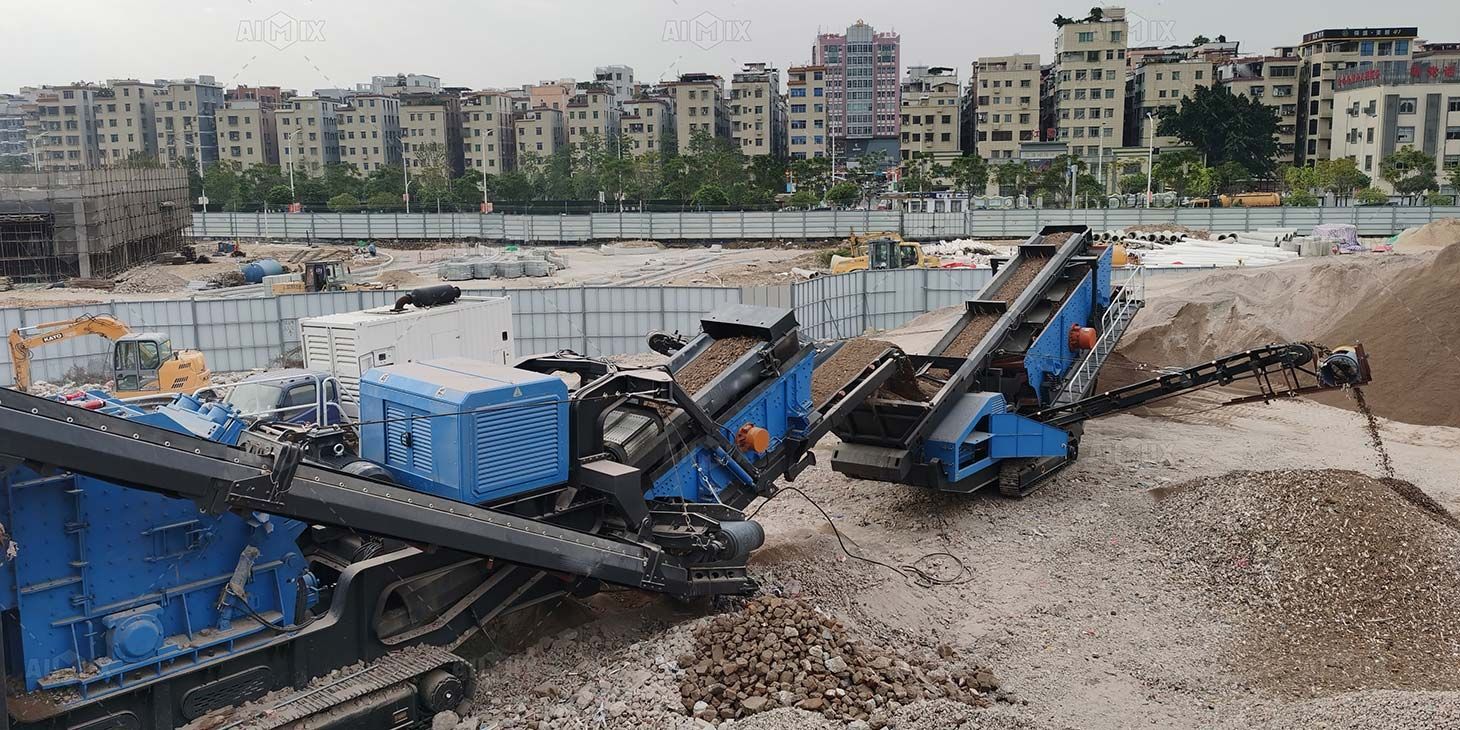
Mobile jaw crusher units, mounted on tracked undercarriages, position directly at the demolition face — receiving material from excavator-mounted hydraulic breakers or from direct demolition loading without intermediate handling. This immediate processing at the point of generation is the fundamental mechanism by which on-site crushing reduces waste accumulation: rubble that would otherwise stockpile as unprocessed demolition waste is converted to crushed material within the same operational cycle as the demolition activity that produces it. The stockpile that remains is processed aggregate rather than demolition rubble — a material with value and utility rather than a waste management liability.

Reinforcement Separation and Steel Recovery in Crushed Concrete Processing

Reinforced concrete demolition material contains embedded steel reinforcement that must be separated from the crushed aggregate before the recycled material meets the cleanliness specifications that most end-use applications require. Magnetic separation systems — overhead magnetic belt conveyors or magnetic drum separators positioned on the crusher's discharge conveyor — extract ferrous reinforcement from the crushed concrete stream automatically as material exits the crushing chamber. The recovered steel, compressed into manageable bundles by the separation process, has salvage value that partially offsets the operating cost of the crushing operation while simultaneously improving the quality of the recycled aggregate product.

Secondary Processing and Specification-Grade Recycled Aggregate Production

Primary crushing reduces demolition rubble to a processable feed size. Secondary crushing — using cone crushers or impact crushers depending on the target product specification and the aggregate application — refines this material to the gradation and particle shape characteristics that usable recycled concrete aggregate requires. Road sub-base applications, structural fill, drainage aggregate, and in some regulatory frameworks lower-grade concrete production each impose specific gradation requirements that secondary crushing and screening circuits are configured to meet.

The production of specification-grade recycled aggregate from demolition concrete transforms the waste reduction narrative from purely a disposal cost avoidance story into a genuine value creation story. Material that entered the processing circuit as a demolition waste liability exits as a saleable or directly reusable construction product — reducing both the volume that requires external disposal and the demand for virgin quarried aggregate in the same operation. This dual benefit is the economic engine that justifies concrete crusher investment for demolition contractors operating at sufficient volume to recover the equipment cost through combined construction waste disposal savings and aggregate production value.

Environmental and Regulatory Benefits of On-Site Concrete Crushing

The environmental case for on-site concrete crushing extends beyond the immediate project site economics. Construction and demolition waste represents one of the largest waste streams by volume in most national waste inventories — a contribution that waste management policy frameworks are increasingly targeting through landfill diversion requirements, recycled content specifications in public procurement, and extended producer responsibility frameworks that make demolition contractors financially accountable for the waste their operations generate.

Landfill Diversion and Carbon Footprint Reduction

Every tonne of concrete demolition material processed on-site into recycled aggregate is a tonne diverted from landfill — a measurable contribution to landfill diversion targets that construction clients, local authorities, and sustainability certification frameworks are increasingly specifying as project performance requirements. LEED, BREEAM, and equivalent green building rating systems award credits for construction waste diversion rates that on-site crushing can help achieve, adding certification value to the operational and economic benefits that crusher deployment delivers.

The carbon footprint reduction associated with on-site concrete crushing operates through multiple simultaneous mechanisms. Fewer waste transport vehicle movements reduce direct fuel consumption and associated emissions. Reduced demand for virgin quarried aggregate decreases the extraction, processing, and transport emissions associated with primary aggregate production. And landfill diversion reduces the methane generation and leachate management impacts associated with organic-contaminated construction waste disposal. Life cycle carbon assessments for demolition projects consistently demonstrate that on-site crushing significantly reduces the project's total environmental impact compared to conventional rubble removal and disposal approaches.

Regulatory Compliance and Waste Classification Advantages

Processed recycled concrete aggregate occupies a different regulatory classification than unprocessed demolition waste in most jurisdictions — a distinction with practical compliance implications that demolition contractors increasingly recognize and actively manage. Unprocessed concrete demolition rubble classified as controlled waste attracts transport licensing requirements, consignment documentation obligations, and disposal site acceptance criteria that add administrative burden and cost to waste management operations. Recycled aggregate produced from that same material through an on-site crushing operation may qualify for end-of-waste status under applicable recycling regulations — exiting the waste regulatory framework entirely and entering the materials market as a specification product subject to product standards rather than waste controls.

Operational Considerations for Effective Crusher Deployment in Demolition Projects

Realizing the waste reduction and value recovery benefits of on-site concrete crushing requires crusher deployment decisions that match equipment capability to project-specific material characteristics, volume requirements, site conditions, and product specifications. Equipment selection, site layout planning, and operational sequencing all influence how effectively a crushing operation captures the available waste reduction opportunity.

Mobile Versus Static Crusher Configuration for Demolition Applications

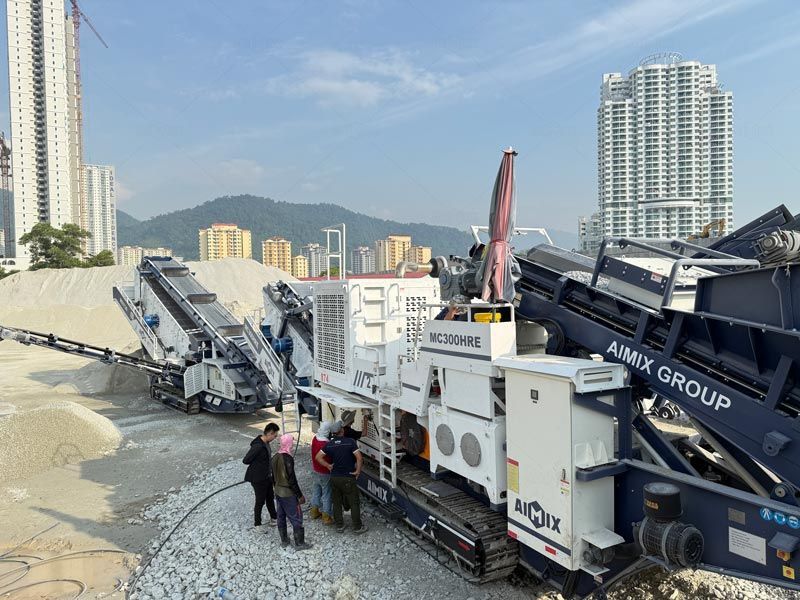
Mobile tracked crusher units offer the site positioning flexibility that demolition project geometry typically demands — the ability to reposition as the demolition front advances, to work within the confined footprint of urban demolition sites, and to access material without the intermediate handling that a fixed processing location would require. For projects where the demolition sequence progresses across a site over an extended period, mobile configurations consistently deliver lower material handling costs and better utilization of crusher capacity than fixed installations that require material to be hauled to a central processing point.

Static or skid-mounted crushing plants offer economic advantages for high-volume demolition programs where sustained throughput justifies the site infrastructure investment — covered aggregate storage, vehicle circulation routes, weighbridge facilities — that fixed installations support. Major infrastructure demolition programs, urban renewal projects clearing multiple city blocks, and dedicated recycled aggregate production facilities processing demolition material from multiple source sites all represent volume profiles where static plant economics can outperform mobile configurations when the full cost comparison is made across the project duration.

Feed Quality Management and Contamination Control

Recycled concrete aggregate quality — and therefore its market value and regulatory status — depends critically on the cleanliness of the demolition material entering the crushing circuit. Contamination by gypsum from plasterboard, wood, plastic, asphalt, and hazardous materials including asbestos-containing products can render recycled aggregate unsuitable for intended end uses and create regulatory compliance complications that undermine the waste diversion benefits that on-site crushing is intended to deliver. Pre-demolition waste surveys, selective demolition sequencing that separates concrete from other waste streams before crushing, and crusher feed management that excludes contaminant materials from the processing circuit are operational disciplines that determine whether a recycled aggregate product meets specification requirements and achieves the waste reduction outcomes that justify the crusher investment in the first place.
By Castillo AIMIX June 17, 2026
Urban demolition has become an increasingly delicate operation across rapidly densifying Latin American cities. As metropolitan centres in Mexico, Colombia, Chile, and Brazil pursue ambitious redevelopment agendas, the volume of concrete demolition waste requiring on-site processing has grown substantially. This expansion has thrust dust emission control into a position of unprecedented operational significance. Concrete crushing machine — an inherently particulate-generating process — poses considerable risk to public health, regulatory compliance, and community relations when conducted without rigorous suppression infrastructure. Understanding why dust-free crushing systems have transitioned from optional enhancement to fundamental requirement is essential for any contractor operating within dense urban demolition contexts. Public Health Imperatives in Densely Populated Demolition Zones Respirable Crystalline Silica Exposure and Community Risk Concrete crushing liberates fine particulate matter containing respirable crystalline silica, a substance classified by international health authorities as carcinogenic upon prolonged inhalation exposure. In construction waste recycling environments embedded within residential neighbourhoods — a common configuration across Mexico City's Iztapalapa district, Bogotá's urban renewal corridors, or São Paulo's central redevelopment zones — uncontrolled dust plumes do not remain confined to the project perimeter. They drift across adjacent streets, infiltrate nearby residences, and settle on surfaces frequented by pedestrians, vendors, and schoolchildren. Dust-free crushing systems, incorporating water misting arrays, enclosed crushing chambers, and negative-pressure extraction units, dramatically reduce ambient particulate concentrations at source, protecting both site personnel and the broader urban population from cumulative silica exposure that conventional crushing operations would otherwise generate unchecked. Occupational Exposure Limits and Worker Protection Standards Beyond community-level risk, demolition crews operating crushing equipment face direct and sustained occupational exposure to airborne particulates. Regulatory frameworks across Chile, Peru, and Argentina have progressively tightened permissible exposure limits for respirable dust, aligning more closely with stringent international occupational health benchmarks. Crushing operations lacking integrated suppression technology routinely exceed these thresholds within minutes of activation, exposing operators to concentrations that accelerate the onset of silicosis, chronic obstructive pulmonary conditions, and other irreversible respiratory pathologies. Dust-free crushing systems — engineered with shrouded conveyor transitions, sealed discharge points, and continuous water atomisation — substantially attenuate this exposure pathway, enabling contractors to satisfy occupational health obligations while maintaining productive crushing throughput across extended operational shifts. Regulatory Compliance and Urban Environmental Governance Municipal Air Quality Ordinances Across Latin American Metropolises Latin America's largest cities have progressively codified air quality governance frameworks that directly constrain demolition and crushing activities. Mexico City's environmental authorities enforce particulate emission ceilings tied to broader metropolitan air basin management strategies, given the capital's well-documented vulnerability to thermal inversion and pollutant accumulation. Santiago, Chile, operates under similarly rigorous atmospheric management protocols, reflecting the city's geographic susceptibility to smog entrapment within its Andean basin topography. Bogotá and Medellín have introduced construction-specific dust mitigation ordinances requiring demonstrable suppression measures as a precondition for demolition permitting. Contractors deploying dust-free crushing systems position themselves favourably within these regulatory architectures, avoiding the punitive fines, work stoppage orders, and permit revocation risks that non-compliant operators increasingly encounter as enforcement intensifies across the region. Documentation, Monitoring, and Permit Renewal Considerations Regulatory compliance in contemporary Latin American demolition contexts extends beyond mere equipment deployment to encompass rigorous documentation and continuous monitoring obligations. Municipal authorities in Brazil's São Paulo and Rio de Janeiro increasingly require contractors to submit particulate monitoring data — captured through portable air quality sensors positioned at site boundaries — as a condition of ongoing permit validity. Dust-free crushing systems equipped with integrated monitoring instrumentation generate the verifiable performance records that satisfy these documentation requirements, while simultaneously providing contractors with operational feedback enabling real-time suppression adjustment. This monitoring capability transforms dust management from a reactive compliance obligation into a proactive operational discipline, reducing the likelihood of regulatory infractions that could otherwise jeopardise project continuity and contractor reputation within increasingly scrutinised urban renewal markets. Operational and Reputational Benefits Beyond Compliance Equipment Longevity and Reduced Mechanical Wear Dust suppression infrastructure delivers operational dividends extending well beyond regulatory and health considerations. Airborne particulate infiltration into mobile impact crusher equipment bearings, hydraulic systems, and electrical control panels accelerates mechanical degradation, generating premature component failure and elevated maintenance frequency. Dust-free crushing systems, through their enclosed processing architecture and water-based suppression mechanisms, substantially reduce ambient particulate ingress into sensitive mechanical assemblies. Contractors operating across Colombia, Chile, and Mexico report measurably extended service intervals and reduced unplanned downtime when transitioning from conventional open-air crushing configurations to enclosed, dust-suppressed alternatives — a maintenance economy that compounds favourably across sustained urban demolition programmes. Community Relations and Contractor Reputation Management In urban demolition contexts where project sites operate in immediate proximity to residential communities, commercial establishments, and civic institutions, visible dust plumes generate disproportionate reputational damage regardless of actual health impact severity. Contractors whose operations produce minimal visible particulate emission cultivate stronger community relations, encounter fewer neighbour complaints lodged with municipal authorities, and experience reduced likelihood of activist or media scrutiny that has, in several documented instances across Latin American cities, escalated into costly project delays or contract terminations. Dust-free crushing systems thus function not merely as compliance instruments but as strategic reputational assets, enabling contractors to sustain the social licence to operate that increasingly determines commercial viability within Latin America's politically attentive and environmentally conscious urban redevelopment landscape.
By Castillo AIMIX June 15, 2026
Indonesia's sprawling archipelago presents a logistical puzzle unlike anywhere else on the planet. With over seventeen thousand islands scattered across volcanic terrain and turquoise straits, moving raw materials from quarry to construction site has historically meant navigating a gauntlet of ferries, barges, and bone-rattling overland routes. Enter the track crusher —a game-changing piece of kit that's quietly rewriting the economics of aggregate supply chains, one mobile crushing run at a time. The Archipelago Logistics Challenge: Why Aggregate Transport Costs Spiral Before diving into solutions, it's worth unpacking exactly why aggregate logistics in Indonesia carry such a hefty price tag. The answer lies in geography, infrastructure gaps, and the compounding nature of multi-leg transport. Inter-Island Shipping Bottlenecks and Fuel Surcharges Transporting bulk crushed stone between islands isn't a simple truck-and-go affair. Materials often require sequential handling—truck to port, port to barge, barge to another port, then another truck leg to the final destination. Each transition point introduces handling fees, waiting times, and fuel surcharges that compound rapidly. Diesel price volatility, particularly in remote provinces where supply chains are thinner, can swing transport budgets dramatically within a single fiscal quarter, leaving project managers scrambling to recalibrate cost projections mid-build. The Hidden Markup of Multi-Stage Hauling Beyond visible freight charges, multi-stage hauling introduces a cascade of less obvious expenses: material degradation during transit, increased insurance premiums for cargo crossing maritime routes, and the opportunity cost of extended lead times. When aggregate must travel hundreds of kilometers from a centralized quarry to a remote jobsite on Sulawesi or Kalimantan, the cumulative markup can inflate raw material costs by staggering percentages compared to the quarry-gate price—a reality that's prompted contractors to rethink their entire procurement playbook. On-Site Crushing as a Cost-Disruption Strategy Rather than fighting the archipelago's geography, forward-thinking operators are sidestepping it entirely. By bringing crushing capability directly to the source material—whether that's demolition rubble, river rock, or quarry-blasted rock face—the entire transport equation gets rewritten. Track Crushers and the Mobility Advantage Track-mounted crushing units bring an almost nomadic quality to aggregate production. Unlike stationary crushing plants in Indonesia tethered to fixed locations, these crawler-equipped machines traverse rough terrain, scale modest gradients, and reposition themselves across active quarry faces or demolition sites with minimal setup downtime. For Indonesian operators working across islands with limited heavy-equipment infrastructure, this self-propelled mobility eliminates the need to ship raw rock to a centralized processing facility—the crusher simply goes where the rock already is. Reducing Material Volume Through Localized Processing Here's where the numbers get genuinely interesting. Raw quarry rock, before crushing, occupies considerable volume relative to its usable output—much of that bulk represents oversized boulders or unusable fines that would otherwise be shipped at full freight cost only to be discarded or reprocessed at the destination. By crushing at the extraction point, operators ship only graded, specification-ready aggregate, dramatically reducing the tonnage that needs to traverse those expensive inter-island routes. It's a classic case of processing intelligence trumping brute-force logistics. Real-World Impact Across Indonesia's Construction Sectors The theoretical cost savings sound compelling, but how does this translate into tangible outcomes across Indonesia's diverse construction landscape? The ripple effects extend well beyond simple line-item budget reductions. Infrastructure Projects in Remote Provinces Government-backed infrastructure initiatives in provinces like Papua, Maluku, and Nusa Tenggara have historically faced punishing material costs simply due to remoteness. Track crushers deployed alongside road-building and bridge projects allow construction teams to source aggregate from local rock formations encountered during excavation, converting what would otherwise be waste spoil into usable base material. This approach has proven particularly transformative for road infrastructure projects, where aggregate represents a substantial proportion of total material volume requirements. Long-Term ROI and Environmental Co-Benefits Beyond immediate cost savings, the shift toward localized crushing carries compounding long-term advantages. Reduced truck and barge traffic translates into lower carbon emissions associated with material transport—an increasingly relevant metric as sustainability certifications gain traction in regional development financing. Additionally, fleet operators report that track crushers, despite higher upfront acquisition costs compared to static alternatives, often achieve payback periods measured in single-digit project cycles when factoring in cumulative freight savings across multiple jobsites. For contractors managing portfolios spanning multiple islands, this versatility transforms a single piece of equipment into a recurring cost-avoidance engine rather than a one-off capital expense. As Indonesia continues its infrastructure expansion across an archipelago that refuses to make logistics easy, track crushers represent more than just incremental efficiency—they signal a fundamental rethink of how aggregate supply chains should function in geographically fragmented markets. By collapsing the distance between extraction and processing, this approach turns one of the archipelago's greatest logistical liabilities into a manageable, increasingly cost-competitive component of the construction equation.